Advert

Credit: AI-generated illustration (2026)
boe international 2027:
Where the future of events takes shape
Which AI solutions deliver real value? Where are clear boundaries needed? And how can technology create a better event experience? At boe international, these questions are explored through concrete applications, new ideas, and direct exchange with the industry. Because the future of events takes shape where technological possibilities, creative design, and human responsibility come together.
The more AI works in the background, the more conscoiusly event professionals must embrace their role in the foreground. Only then can the technology create new room for creativity, service, and personal interactions.
AI in action: From planning to follow-up
Used effectively, AI can support the entire event process. It does not direct the event itself, but serves as a co-director: fast, data-driven, and versatile, yet always embedded in a clearly defined, human-led concept.
Before the event—laying the groundwork: During the early planning phase, AI can help structure briefings, segment target audiences, or translate event objectives into measurable metrics. It can also compare budget scenarios, draft initial risk scenarios, and condense extensive materials into a solid basis for decision-making. This also opens up new possibilities for communication: content can be adapted for different audiences, invitations personalized, and frequently asked questions identified early. Human review remains essential: Are the assumptions realistic? Does the language match the brand’s tone? Are audiences being considered in a nuanced way, or grouped into oversimplified categories?
During preparation—reducing complexity: As an event draws closer, more planning updates and information converge. Schedules change, service providers need updates, speaker briefings are revised, and attendee questions accumulate. AI can summarize content, structure meeting notes, update task lists, and identify discrepancies between different versions of plans. Translations can be prepared more quickly, and internal information can be made easier to find. Yet the benefit is not limited to speed. Those who spend less time on routine tasks can focus more on quality, collaboration, and necessary coordination. But speed is not the same as reliability. Particularly with production data, contracts, safety-related information, or binding schedules, results must be checked rigorously.
During the event—responding faster: During live operations, AI can support personalized session recommendations, matchmaking, live translation, digital service assistants, and visitor-flow analysis. When lines form, rooms reach capacity, or individual offerings see particularly high demand, up-to-date data enables timely and targeted responses. Staffing, signage, or communications can then be adjusted immediately. The benefit, however, depends on how transparently the application is integrated. The limit is reached when analysis turns into surveillance or attendees can no longer understand which data is being used for what purpose. Technology should support the experience, not dominate it. AI is often especially effective when it works unobtrusively in the background, creating space for genuine human interaction in the foreground.
After the event—learning from data:
After the event, feedback must be evaluated, leads prioritized, and insights prepared for partners or internal stakeholders. AI can organize feedback by topic, summarize sessions, prepare follow-ups, and identify patterns across multiple events. But data never tells the whole story. A sparsely attended session may have been particularly valuable to a small, strategically important audience. A high engagement score does not automatically mean that a format is a good long-term fit for the brand. AI provides signals. Event professionals interpret them, derive insights, and decide which ones should inform the next planning cycle.
New skills for event teams
AI is also changing the role of event professionals. They are increasingly becoming strategic curators and quality gatekeepers. This requires an understanding of processes, data literacy, expert judgment, and the ability to critically assess AI-generated results. It also requires the ability to design workflows with clearly defined responsibilities, review processes, and escalation levels. Good prompts help, but they are not enough. Empathy, a strong commitment to quality, and a sure sense of audiences, brands, and situations are equally important.
AI writes copy, analyzes data, and develops new ideas in seconds. But technical speed alone does not make an event compelling. What matters is whether organizers ask the right questions, set clear boundaries, and turn the results into real impact. The more capable the systems become, the more important the human role remains.
Credit: AI-generated illustration (2026)
AI-generated illustration (2026)
Using AI effectively:
Why event professionals need more than good prompts
What event professionals can learn from this
The event industry offers a particularly wide range of applications for AI. Few other fields bring together so much data, so many processes, disciplines, audiences, and communication touchpoints in such a short period of time. This very complexity is also why event teams need to proceed in a structured way and with a specific objective. The best starting point is not the largest possible transformation project. A clearly defined use case with tangible value is more effective. For example, a team can begin by consolidating recurring attendee questions, evaluating feedback, or comparing different process scenarios. What matters is that the process does not end with the AI-generated result.
AI can sort hundreds of open-ended responses from an attendee survey by topic and identify recurring points of criticism. However, the event team must assess whether a response is actually relevant, what expectation lies behind it, and what action should be taken as a result. The same applies to concept development. AI can provide ideas for program elements, spatial concepts, or communications. But it knows neither a client’s unspoken expectations nor the dynamics within an organization. That is why every use case should first be tested on a small scale. What data was used? How reliable were the results? Where were corrections needed? Did the team actually save time, or did it merely create additional review loops? This turns an initial tool test into a learning process. Successful applications can be expanded step by step, while unsuitable ones can be discontinued early.
Using AI intelligently follows a simple logic: Understand the problem. Design the process. Assess the impact. Only then should the appropriate tool be selected.
Human-in-the-Loop: Impact still needs a human director
Events are not purely logistical products. They thrive on atmosphere, timing, attitude, and human connection. A space can be planned perfectly and still feel impersonal. A program element can meet every formal criterion and yet fail to move anyone.
KI zeigt Zusammenhänge auf. Ihre Relevanz beurteilt der Mensch.
This is precisely where the “human-in-the-loop” principle comes in. Humans are not simply the final reviewers who click “approve” at the end. They define the objective, provide context, set boundaries, evaluate results, and take responsibility. The aim is not to prevent every automated decision. What matters, instead, is to define clearly where automation makes sense and where human judgment remains essential.
AI can triage general support inquiries. By contrast, safety reports, sensitive audiences, or conflict situations require defined escalation pathways and human points of contact. AI can suggest suitable networking contacts. Whether this leads to a valuable connection depends on the personal conversation. It can forecast attendance for a session. Yet whether the topic advances the industry cannot be inferred from past click data alone.
Creativity, too, is more than rapidly producing a large number of ideas. If every team uses similar applications, content and formats risk becoming interchangeable.
Why so many AI projects fail
Many AI initiatives begin in the wrong order. First, a tool is selected. Then the team looks for a task it can perform. What appears modern often remains an isolated experiment: a chatbot without a well-maintained knowledge base, an automated email campaign without a clearly defined target audience, or a dashboard whose data does not lead to any action. Such projects usually fail not because of the technology, but because its use is not tied to concrete objectives, clearly assigned responsibilities, and traceable review processes.
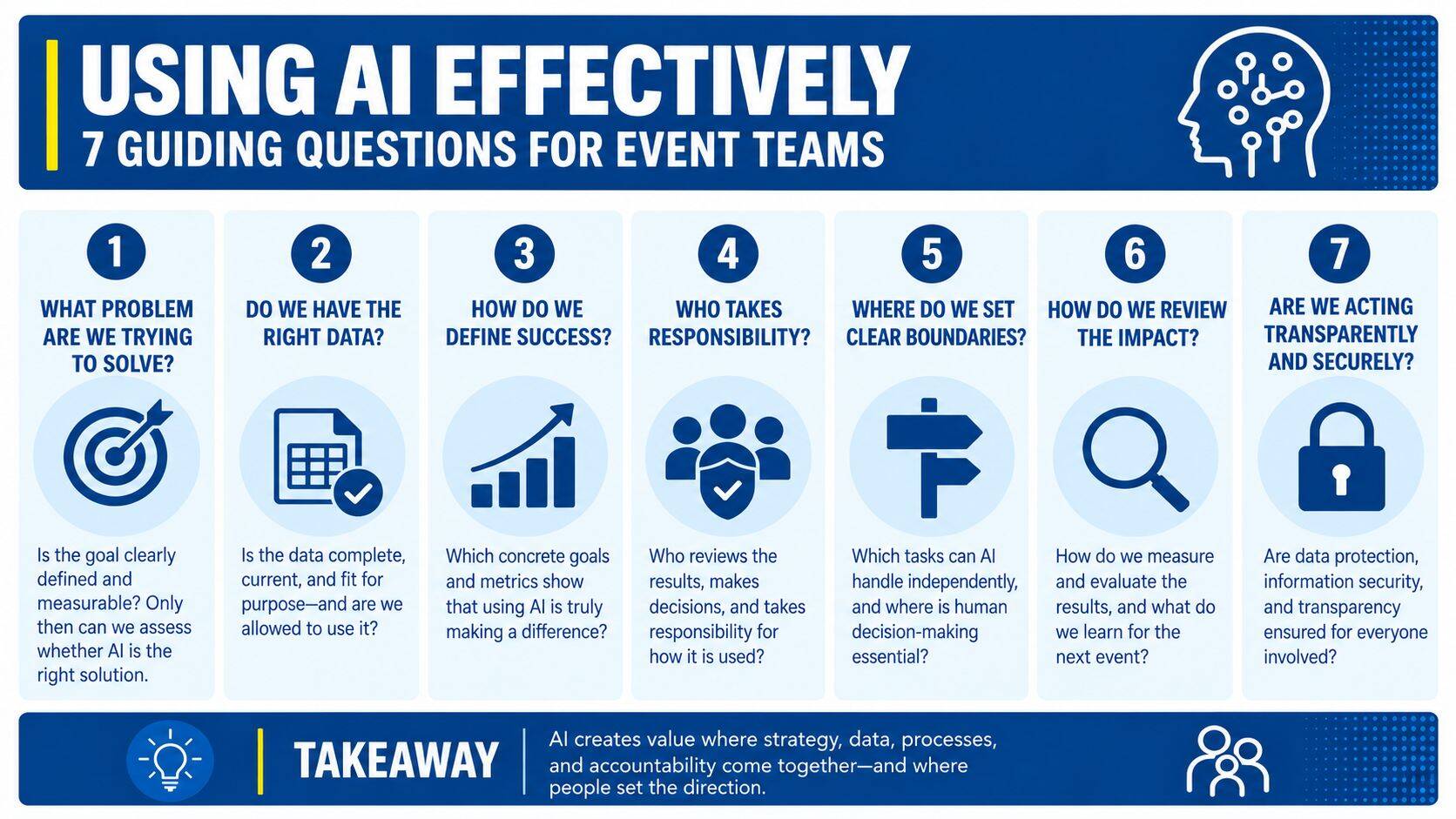
The problem is not defined clearly enough: “We want to do something with AI” is not a project objective. Event teams need to state specifically what they want to achieve: Should communication become more efficient? Should inquiries be reduced, leads be better qualified, or visitor flows be assessed more reliably? Is the aim to reduce coordination effort, improve content, or conduct more precise follow-up? Only once the specific reason for the project has been clearly described can it be assessed whether AI is actually the right solution. Sometimes what is needed is not a new system, but a simpler process or a clear assignment of responsibility.
The data foundation is insufficient: AI needs context. However, relevant event data is often stored across numerous separate systems: ticketing platforms, CRM solutions, apps, feedback tools, spreadsheets, emails, or project folders. If this information is incomplete, inconsistent, or outdated, it will not produce reliable insights. AI processes poor data quickly, too, but that does not make the data any better. It must also be clear which data may be used for what purpose. Just because information is technically available does not mean it automatically belongs in every system. Data privacy and transparency must therefore be part of the project from the outset.
Success is not defined: A project is not successful simply because a text was written faster or an application looks impressive. Measurable criteria are needed. These can include hours of work saved, shorter response times, better data quality, higher satisfaction scores, or better-qualified leads. Fewer errors or faster approvals can also be relevant success metrics. Without such criteria, there is no way to demonstrate whether the use of AI actually delivers an improvement.
Responsibility remains unclear: Who reviews the results? Who decides whether to use them? And who bears responsibility if incorrect information is communicated or critical connections are overlooked? These questions need to be addressed at the outset of every project. Responsibility cannot be delegated to a system, even when its answers sound plausible.
The AI hype meets reality
Concepts in minutes, personalized invitations, audience analyses, and schedules at the touch of a button: AI is supposed to ease the workload for event teams, accelerate processes, and make events more successful. Many event professionals already use such applications for copy, translations, research, visual ideas, or presentations. Others are testing chatbots, automated analyses, and recommendations for attendees. What was still a distant prospect just a few years ago is increasingly becoming part of everyday work.
Yet there is a major difference between a good prompt and a successful event. Trying out a tool does not in itself improve a process. And a quickly generated result is not necessarily a better one. In the event industry in particular, technological progress meets a complex reality: many stakeholders, last-minute changes, sensitive data, tight budgets, and high standards for quality, safety, and the overall experience.
AI can simplify many things in this environment. But it can neither replace a missing objective nor repair an unclear strategy. Often, it first reveals where processes are not clearly defined, information is poorly maintained, or responsibilities are not clearly assigned. Its real value therefore does not lie in automating as many tasks as possible. Rather, its value emerges where AI supports better decisions, makes connections visible more quickly, and creates room for concept development, creativity, and personal interaction. The crucial question is therefore no longer whether we use AI, but where it contributes to the team, the process, and ultimately the event.

Credit: AI-generated illustration (2026)
Credit: AI-generated illustration (2026)
Why so many AI projects fail
Many AI initiatives begin in the wrong order. First, a tool is selected. Then the team looks for a task it can perform. What appears modern often remains an isolated experiment: a chatbot without a well-maintained knowledge base, an automated email campaign without a clearly defined target audience, or a dashboard whose data does not lead to any action. Such projects usually fail not because of the technology, but because its use is not tied to concrete objectives, clearly assigned responsibilities, and traceable review processes.
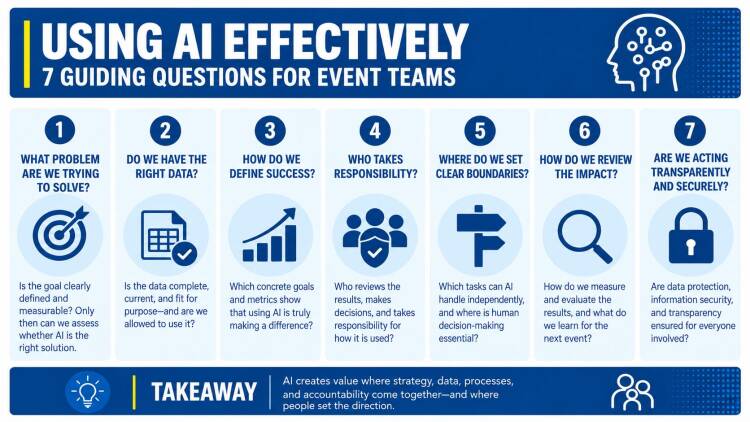
The problem is not defined clearly enough: “We want to do something with AI” is not a project objective. Event teams need to state specifically what they want to achieve: Should communication become more efficient? Should inquiries be reduced, leads be better qualified, or visitor flows be assessed more reliably? Is the aim to reduce coordination effort, improve content, or conduct more precise follow-up? Only once the specific reason for the project has been clearly described can it be assessed whether AI is actually the right solution. Sometimes what is needed is not a new system, but a simpler process or a clear assignment of responsibility.
The data foundation is insufficient: AI needs context. However, relevant event data is often stored across numerous separate systems: ticketing platforms, CRM solutions, apps, feedback tools, spreadsheets, emails, or project folders. If this information is incomplete, inconsistent, or outdated, it will not produce reliable insights. AI processes poor data quickly, too, but that does not make the data any better. It must also be clear which data may be used for what purpose. Just because information is technically available does not mean it automatically belongs in every system. Data privacy and transparency must therefore be part of the project from the outset.
Success is not defined: A project is not successful simply because a text was written faster or an application looks impressive. Measurable criteria are needed. These can include hours of work saved, shorter response times, better data quality, higher satisfaction scores, or better-qualified leads. Fewer errors or faster approvals can also be relevant success metrics. Without such criteria, there is no way to demonstrate whether the use of AI actually delivers an improvement.
Responsibility remains unclear: Who reviews the results? Who decides whether to use them? And who bears responsibility if incorrect information is communicated or critical connections are overlooked? These questions need to be addressed at the outset of every project. Responsibility cannot be delegated to a system, even when its answers sound plausible.

Advert

boe international 2027:
Where the future of events takes shape
Which AI solutions deliver real value? Where are clear boundaries needed? And how can technology create a better event experience? At boe international, these questions are explored through concrete applications, new ideas, and direct exchange with the industry. Because the future of events takes shape where technological possibilities, creative design, and human responsibility come together.
The more AI works in the background, the more conscoiusly event professionals must embrace their role in the foreground. Only then can the technology create new room for creativity, service, and personal interactions.
AI in action: From planning to follow-up
Used effectively, AI can support the entire event process. It does not direct the event itself, but serves as a co-director: fast, data-driven, and versatile, yet always embedded in a clearly defined, human-led concept.
Before the event—laying the groundwork: During the early planning phase, AI can help structure briefings, segment target audiences, or translate event objectives into measurable metrics. It can also compare budget scenarios, draft initial risk scenarios, and condense extensive materials into a solid basis for decision-making. This also opens up new possibilities for communication: content can be adapted for different audiences, invitations personalized, and frequently asked questions identified early. Human review remains essential: Are the assumptions realistic? Does the language match the brand’s tone? Are audiences being considered in a nuanced way, or grouped into oversimplified categories?
During preparation—reducing complexity: As an event draws closer, more planning updates and information converge. Schedules change, service providers need updates, speaker briefings are revised, and attendee questions accumulate. AI can summarize content, structure meeting notes, update task lists, and identify discrepancies between different versions of plans. Translations can be prepared more quickly, and internal information can be made easier to find. Yet the benefit is not limited to speed. Those who spend less time on routine tasks can focus more on quality, collaboration, and necessary coordination. But speed is not the same as reliability. Particularly with production data, contracts, safety-related information, or binding schedules, results must be checked rigorously.
During the event—responding faster: During live operations, AI can support personalized session recommendations, matchmaking, live translation, digital service assistants, and visitor-flow analysis. When lines form, rooms reach capacity, or individual offerings see particularly high demand, up-to-date data enables timely and targeted responses. Staffing, signage, or communications can then be adjusted immediately. The benefit, however, depends on how transparently the application is integrated. The limit is reached when analysis turns into surveillance or attendees can no longer understand which data is being used for what purpose. Technology should support the experience, not dominate it. AI is often especially effective when it works unobtrusively in the background, creating space for genuine human interaction in the foreground.
After the event—learning from data:
After the event, feedback must be evaluated, leads prioritized, and insights prepared for partners or internal stakeholders. AI can organize feedback by topic, summarize sessions, prepare follow-ups, and identify patterns across multiple events. But data never tells the whole story. A sparsely attended session may have been particularly valuable to a small, strategically important audience. A high engagement score does not automatically mean that a format is a good long-term fit for the brand. AI provides signals. Event professionals interpret them, derive insights, and decide which ones should inform the next planning cycle.
New skills for event teams
AI is also changing the role of event professionals. They are increasingly becoming strategic curators and quality gatekeepers. This requires an understanding of processes, data literacy, expert judgment, and the ability to critically assess AI-generated results. It also requires the ability to design workflows with clearly defined responsibilities, review processes, and escalation levels. Good prompts help, but they are not enough. Empathy, a strong commitment to quality, and a sure sense of audiences, brands, and situations are equally important.
What event professionals can learn from this
The event industry offers a particularly wide range of applications for AI. Few other fields bring together so much data, so many processes, disciplines, audiences, and communication touchpoints in such a short period of time. This very complexity is also why event teams need to proceed in a structured way and with a specific objective. The best starting point is not the largest possible transformation project. A clearly defined use case with tangible value is more effective. For example, a team can begin by consolidating recurring attendee questions, evaluating feedback, or comparing different process scenarios. What matters is that the process does not end with the AI-generated result.
AI can sort hundreds of open-ended responses from an attendee survey by topic and identify recurring points of criticism. However, the event team must assess whether a response is actually relevant, what expectation lies behind it, and what action should be taken as a result. The same applies to concept development. AI can provide ideas for program elements, spatial concepts, or communications. But it knows neither a client’s unspoken expectations nor the dynamics within an organization. That is why every use case should first be tested on a small scale. What data was used? How reliable were the results? Where were corrections needed? Did the team actually save time, or did it merely create additional review loops? This turns an initial tool test into a learning process. Successful applications can be expanded step by step, while unsuitable ones can be discontinued early.
Using AI intelligently follows a simple logic: Understand the problem. Design the process. Assess the impact. Only then should the appropriate tool be selected.
Human-in-the-Loop: Impact still needs a human director
Events are not purely logistical products. They thrive on atmosphere, timing, attitude, and human connection. A space can be planned perfectly and still feel impersonal. A program element can meet every formal criterion and yet fail to move anyone.
KI zeigt Zusammenhänge auf. Ihre Relevanz beurteilt der Mensch.
This is precisely where the “human-in-the-loop” principle comes in. Humans are not simply the final reviewers who click “approve” at the end. They define the objective, provide context, set boundaries, evaluate results, and take responsibility. The aim is not to prevent every automated decision. What matters, instead, is to define clearly where automation makes sense and where human judgment remains essential.
AI can triage general support inquiries. By contrast, safety reports, sensitive audiences, or conflict situations require defined escalation pathways and human points of contact. AI can suggest suitable networking contacts. Whether this leads to a valuable connection depends on the personal conversation. It can forecast attendance for a session. Yet whether the topic advances the industry cannot be inferred from past click data alone.
Creativity, too, is more than rapidly producing a large number of ideas. If every team uses similar applications, content and formats risk becoming interchangeable.
AI writes copy, analyzes data, and develops new ideas in seconds. But technical speed alone does not make an event compelling. What matters is whether organizers ask the right questions, set clear boundaries, and turn the results into real impact. The more capable the systems become, the more important the human role remains.
The AI hype meets reality
Concepts in minutes, personalized invitations, audience analyses, and schedules at the touch of a button: AI is supposed to ease the workload for event teams, accelerate processes, and make events more successful. Many event professionals already use such applications for copy, translations, research, visual ideas, or presentations. Others are testing chatbots, automated analyses, and recommendations for attendees. What was still a distant prospect just a few years ago is increasingly becoming part of everyday work.
Yet there is a major difference between a good prompt and a successful event. Trying out a tool does not in itself improve a process. And a quickly generated result is not necessarily a better one. In the event industry in particular, technological progress meets a complex reality: many stakeholders, last-minute changes, sensitive data, tight budgets, and high standards for quality, safety, and the overall experience.
AI can simplify many things in this environment. But it can neither replace a missing objective nor repair an unclear strategy. Often, it first reveals where processes are not clearly defined, information is poorly maintained, or responsibilities are not clearly assigned. Its real value therefore does not lie in automating as many tasks as possible. Rather, its value emerges where AI supports better decisions, makes connections visible more quickly, and creates room for concept development, creativity, and personal interaction. The crucial question is therefore no longer whether we use AI, but where it contributes to the team, the process, and ultimately the event.
Using AI effectively:
Why event professionals need more than good prompts
AI-generated illustration (2026)