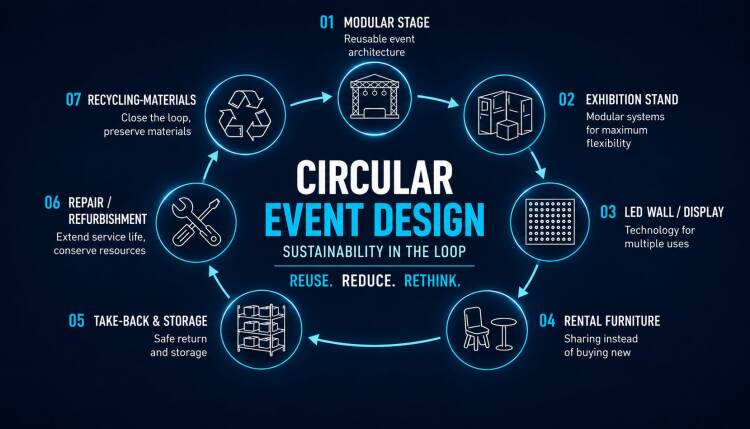
Image credit: AI-generated illustration (2026)
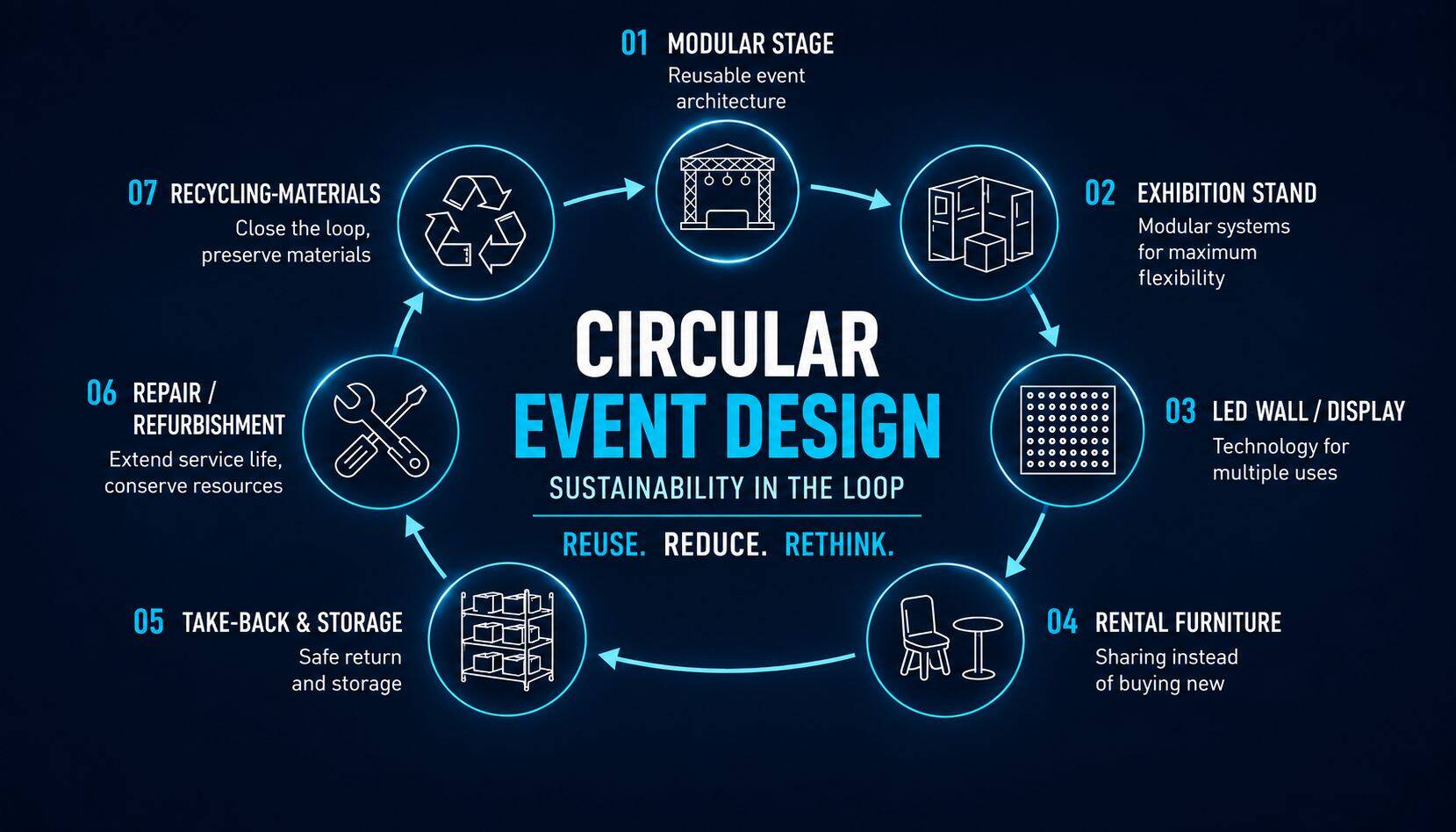
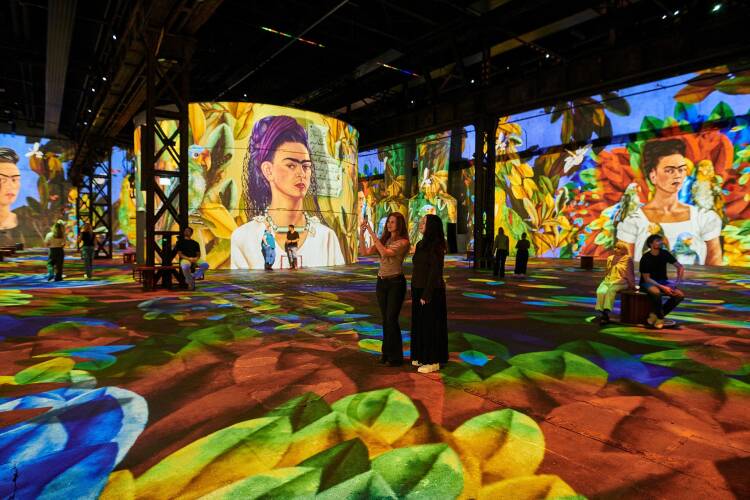
Image © Culturespaces / Markus Mielek
The Future Belongs to Experiential Spaces
In the future, events will be designed to be smarter, more adaptable, and more resource-conscious—while also being more deliberately tailored to how people perceive, use, and help shape spaces. Anyone who wants to inspire visitors must therefore think beyond purely visual effects. Effective concepts create atmosphere, accommodate different uses, use resources responsibly, and encourage people to interact.
Event design is evolving at precisely this intersection of technology, architecture, sustainability, and experience. At boe international 2027, this interplay can be experienced holistically: visitors can see it, try it out, discuss it, and take the ideas further. What will define tomorrow’s events takes shape here.
Trend 5: Shareable Experiences Instead of Traditional Photo Spots
Today’s event visitors take home memories and often also create content for social media. Photos, Reels, and Stories have long been part of the experience of attending many events.
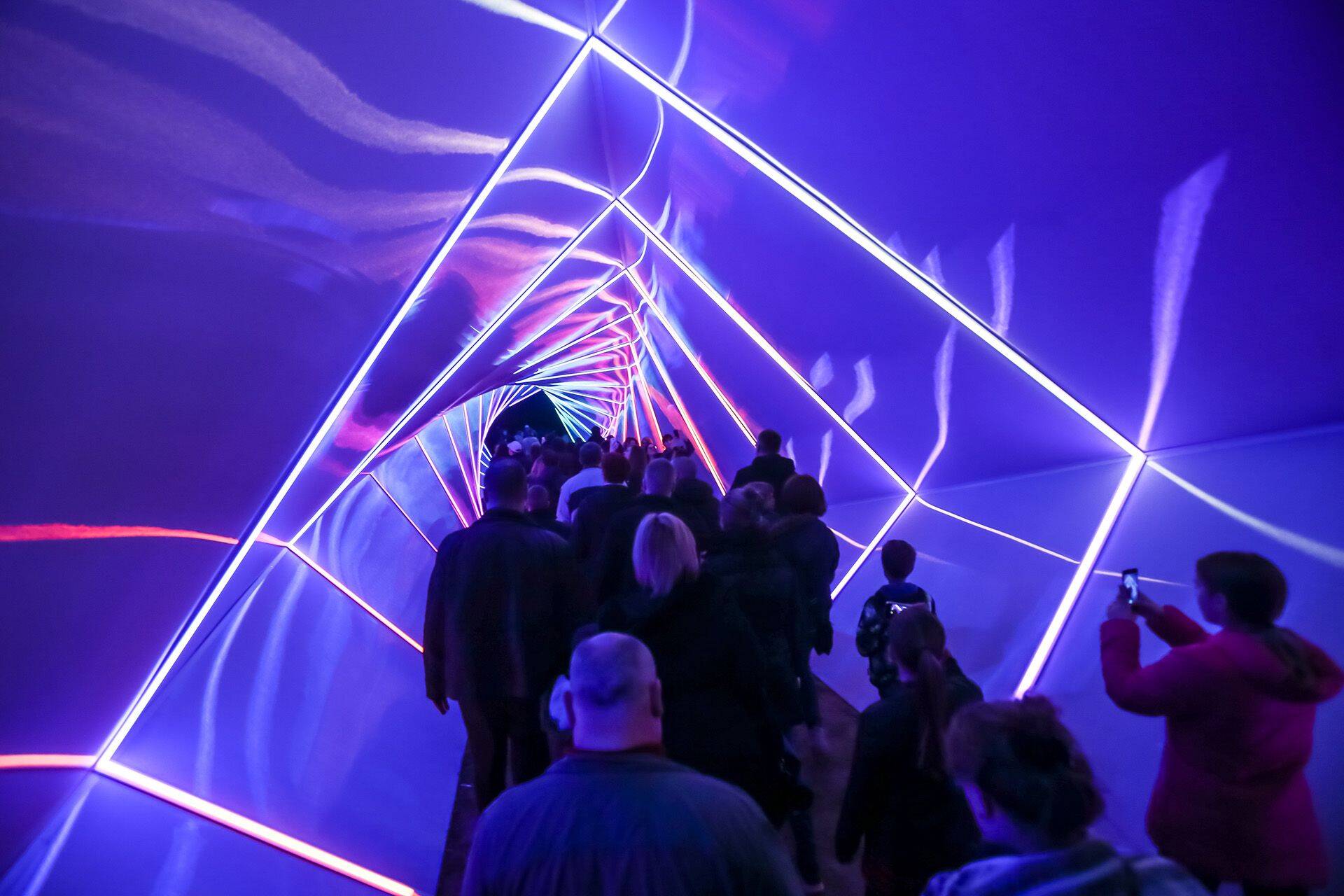
Individual photo backdrops are increasingly being replaced by experiential spaces that visitors can discover, stage, and turn into their own content. Space, light, movement, and perspective come together to form a coherent whole. Well-designed staging creates visually memorable moments that emerge organically from the event concept.
The digital extension begins during the visit itself, with images, videos, and guests’ personal perspectives. For event designers, this means that spaces are conceived not only for the immediate experience, but also with an eye to how impressions and content can be shared through media.
Shareability is factored into the design from the outset. What matters are spaces that not only make an immediate impact, but also encourage visitors to capture and share their own perspectives.
Powerful moments continue to resonate digitally.
Trend 4: Visitors Become Co-Creators
The traditional spectator role is becoming less important. Modern events increasingly involve visitors actively in what is happening. Technologies such as sensor technology, motion tracking, and AI-based applications open up new possibilities: installations respond, content adapts, and each interaction can take a different course.
Gamification also plays an important role. Playful elements can motivate people to take an active role, focus attention, and make topics accessible in new ways. Instead of a sequence that is identical for everyone, different experiences can emerge depending on how visitors interact with offerings, spaces, and themes. Whether digital challenges, interactive brand environments, or collaborative applications, the key is that opportunities to participate do not become an end in themselves, but are meaningfully integrated into the overall experience.
Interaction changes event dramaturgy. Visitors do more than experience content; they influence the course of events and what is on offer—and can consequently develop a stronger connection to topics, products, or brands.
Interaction makes experiences more personal.
Trend 3: Reuse Instead of Single-Use Design
Just a few years ago, many event structures were designed for one-time use. Trade show booths, stage sets, and decorative elements disappeared after just a few days—often involving significant consumption of materials and resources.
Today, the focus is on the life cycle of materials and components. The planning stage already raises the question of what happens to floor coverings, furniture, structures, or decorative elements after the event. Can they be reused, repurposed, or returned to existing material cycles? Temporary design is thus planned beyond a single event. In addition to environmental benefits, using existing resources for longer can also make economic sense: the need for new production can be reduced, waste volumes lowered, and recurring events planned more proactively and cost-effectively.
Sustainability becomes a visible design principle. Materials, structures, and components remain in circulation longer and can, along with their history, become part of new staged experiences.
Designed once, used many times.
© Kristof Lemp
Showcase: Parrtjima Festival of Light, Australia
The Parrtjima Festival of Light in Alice Springs on Arrernte Country demonstrates just how powerfully light can tell stories. Every year, colors, projections, and digital installations transform the landscape of Central Australia into an immersive experiential world, offering a distinctive way to experience the art and stories of First Nations artists. The natural environment itself becomes part of the design. Light serves as a medium for storytelling, combining contemporary technology with culture, Country, and knowledge thousands of years old in a multilayered presentation.
Trend 2: Spaces That Can Adapt
A professional conference with an accompanying exhibition, workshops, and a networking zone by day; an awards ceremony in the evening. Today, different types of formats can all be part of a single event. Rigid spatial concepts quickly reach their limits in such settings. What’s needed are spaces that can flexibly adapt to different program elements, group sizes, and uses.
Movable partitions, adjustable stages, and mobile furniture make it possible to reconfigure spaces quickly and use them for different purposes simultaneously. Atmosphere, wayfinding, and brand impact must be maintained even as configurations change.
Spatial flexibility becomes a design quality in its own right. What matters is no longer just how a space looks, but how versatile it is in use.
One space, many scenarios.
© Goran Jakus Photography – iStock by Getty Images
Event Design 2027:
5 Trends at the Intersection of Technology, Space, and Experience
Trend 1: Light Becomes an Experiential Space
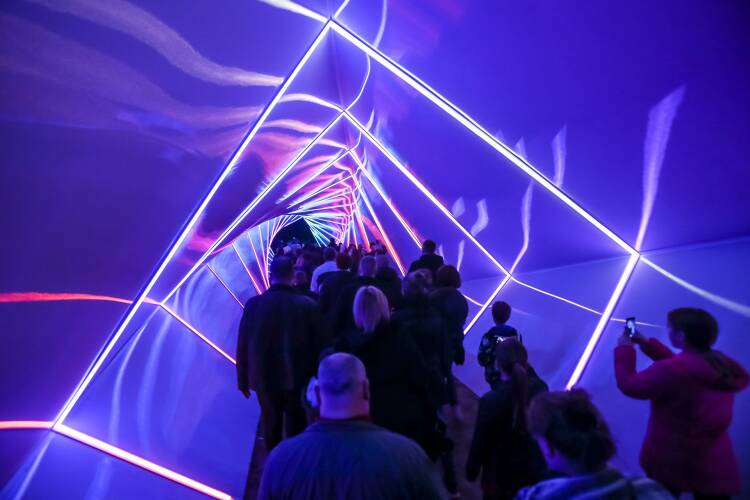
For a long time, light was primarily a functional element of events. Today, it takes on far more roles: it shapes spaces, evokes emotions, and tells stories. Modern lighting concepts create experiential spaces whose atmosphere can be felt immediately.
High-performance LED technology, large-scale projections, and intelligent control systems expand the scope for design. Dynamic lighting designs can respond to music, movement, or program content and continually change the impact of a space. Projection mapping, in particular, opens up additional spatial dimensions: facades, stage sets, or entire landscapes become projection surfaces on which stories are made visible. AI-based applications could also be used more extensively in automated lighting control in the future.
Lighting design thus evolves from a design element into a dramaturgical tool. Brand environments, themes, and emotions can be translated into space, while the boundaries between architecture, technology, and staging become more fluid.
Light becomes the language of space.
Today’s event planners design far more than spaces. They create experiential worlds that evoke emotions, engage people in a targeted way, and take sustainability into account from the outset. Immersive lighting designs, flexible spatial concepts, and interactive installations open up new possibilities for design and use. At the same time, the role of participants is changing: they don’t just experience events—they are increasingly becoming part of the staged experience themselves.
Looking ahead to 2027, the trend is less about a single new technology and more about an ever-closer interplay between space, technology, sustainability, and participation. It is this connection that shapes the next generation of event design.
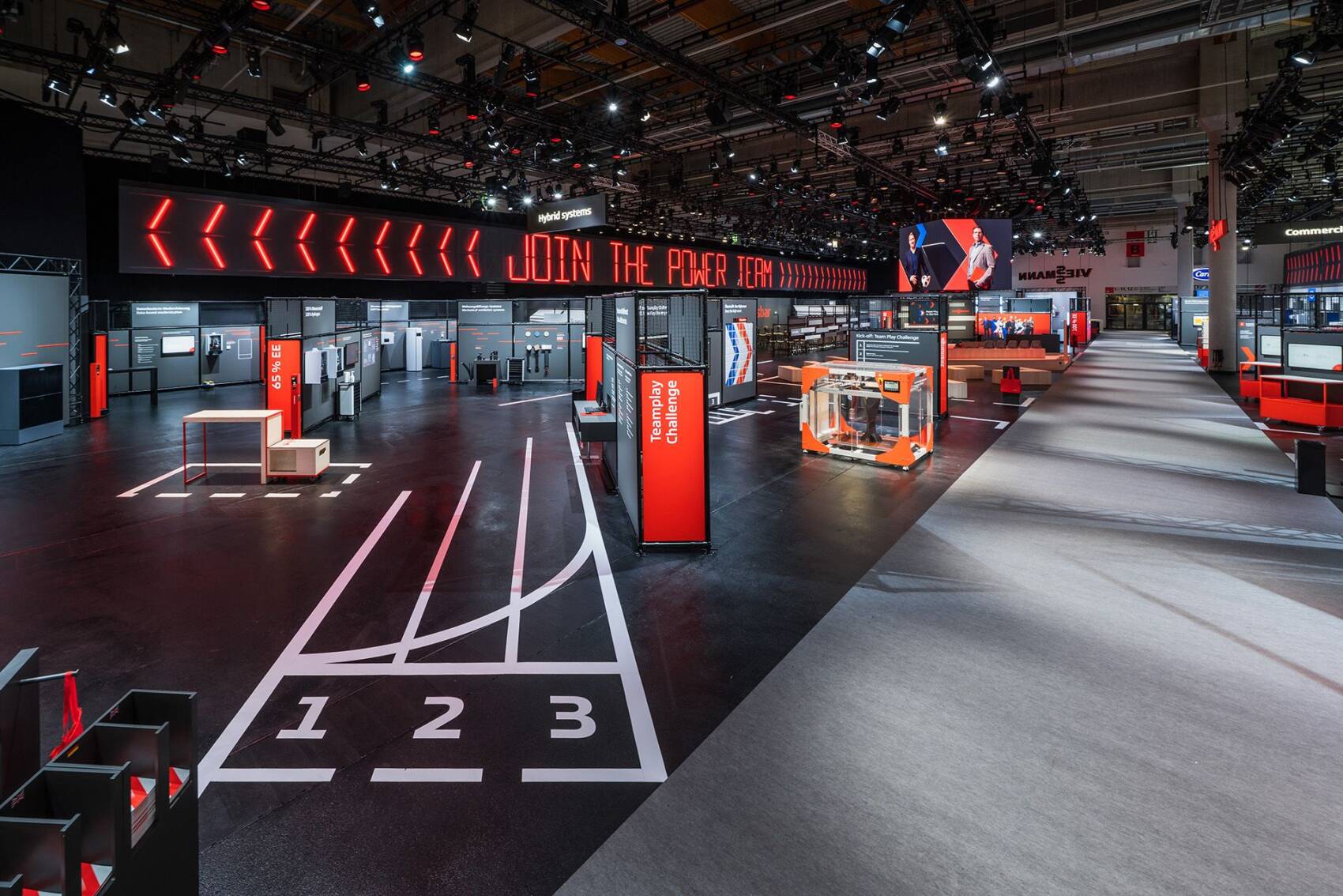
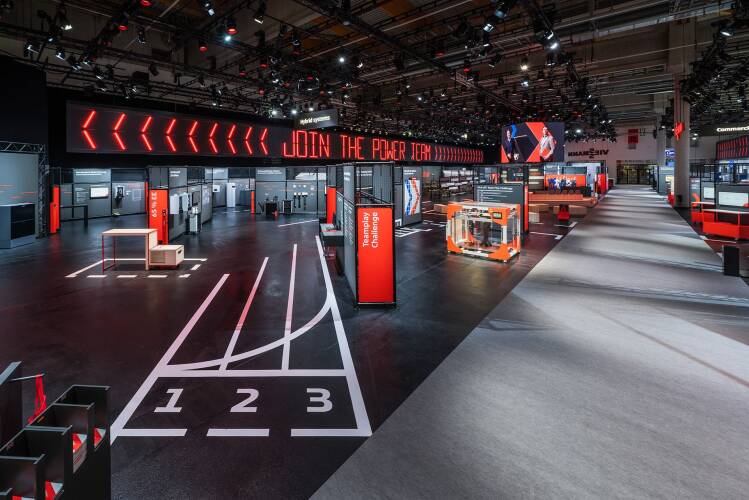
Showcase: Reuse in Viessmann’s Trade Show Presence
Viessmann Climate Solutions, together with Atelier Markgraph, demonstrated how reuse can be factored in from the concept stage at a trade show in 2025. The sustainability approach already pursued in 2023 was systematically developed further. The focus was on reduced material use, a new modular construction standard, and a high reuse rate following the 3R principle “Rethink, Reduce, Re-Use.” The trade show presence was thus conceived from the outset to extend beyond the duration of the event. This is precisely where the key shift in perspective lies: temporary event design is no longer necessarily created for one-time use. How materials and components can be reused afterward is considered during planning.
For this approach, Viessmann Climate Solutions was nominated for the Designplus Award by ISH in the “Sustainable Exhibition Stand” category.
Showcase : Phoenix des Lumières
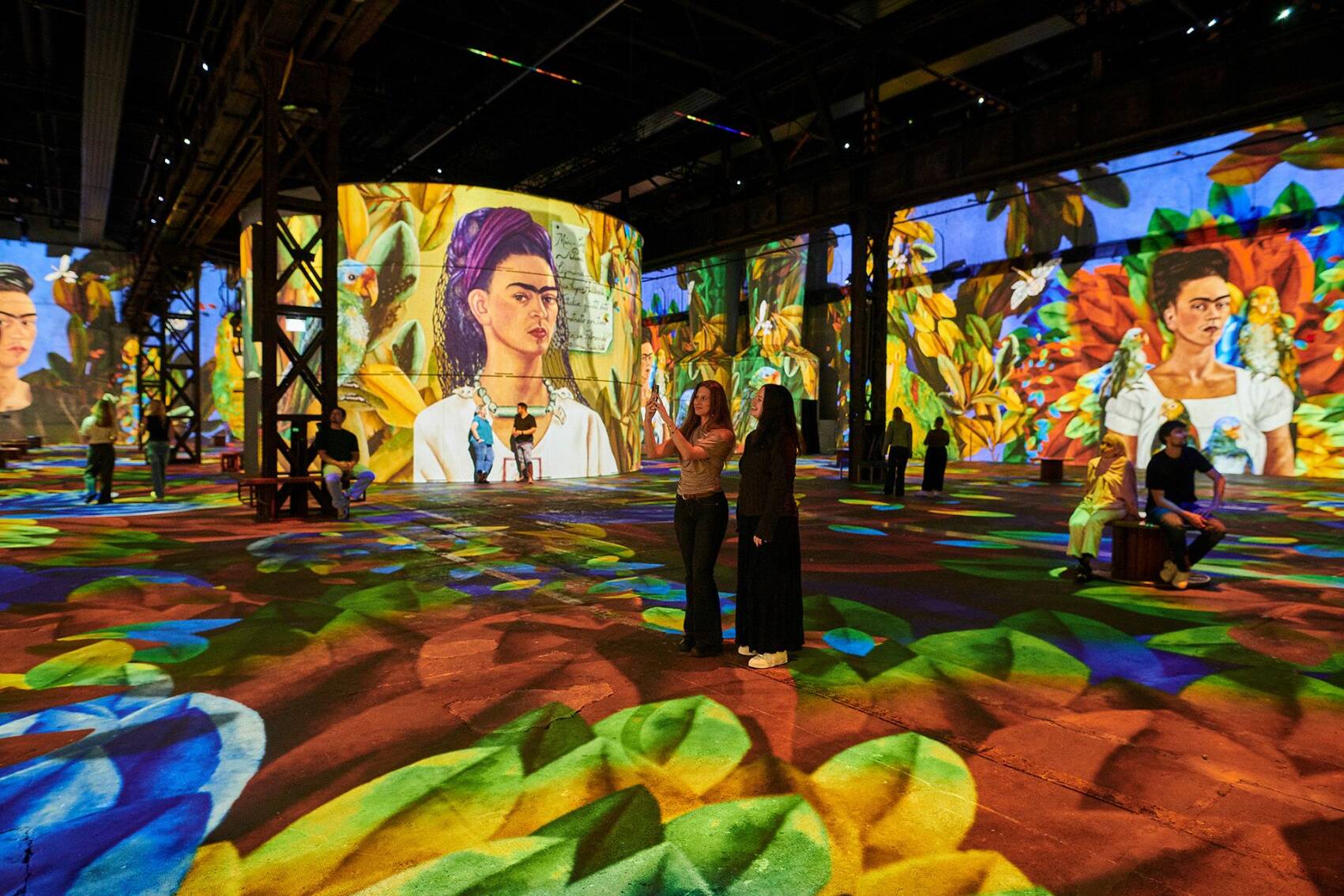
At Phoenix des Lumières in Dortmund, works of art become spatial experiences. Large-scale projections, digital imagery, and room-filling soundscapes transform the former industrial hall into an immersive environment that visitors can actively explore. Changing perspectives continually create new subjects for photos and videos.
Showcase : Award-Winning Immersive Hangar Experience
The award-winning “Immersive Hangar Experience” by the Visual Europe Group illustrates just how far this approach can already go. For the opening of the United Illusions Virtual Production Studio, a hangar was transformed into an interactive experiential world where visitors could influence visual content themselves. Virtual graffiti walls responded to movement, while interactive LED and AI applications turned spectators into active participants. The launch received an award in the “Best Technical Event Service” category at the Flash Award 2025.
Showcase : Palais 2 l’Atlantique, Bordeaux, France
The Palais 2 l’Atlantique in Bordeaux demonstrates how effectively spaces can adapt to changing formats and uses. The large hall features movable telescoping bleachers and mobile partitions that allow different spatial configurations within the same area. Depending on what is needed, smaller meeting areas, plenary setups, or large spaces can be arranged.
Trend 1: Light Becomes an Experiential Space
For a long time, light was primarily a functional element of events. Today, it takes on far more roles: it shapes spaces, evokes emotions, and tells stories. Modern lighting concepts create experiential spaces whose atmosphere can be felt immediately.
High-performance LED technology, large-scale projections, and intelligent control systems expand the scope for design. Dynamic lighting designs can respond to music, movement, or program content and continually change the impact of a space. Projection mapping, in particular, opens up additional spatial dimensions: facades, stage sets, or entire landscapes become projection surfaces on which stories are made visible. AI-based applications could also be used more extensively in automated lighting control in the future.
Lighting design thus evolves from a design element into a dramaturgical tool. Brand environments, themes, and emotions can be translated into space, while the boundaries between architecture, technology, and staging become more fluid.
Light becomes the language of space.
Image © Culturespaces / Markus Mielek
© Goran Jakus Photography – iStock by Getty Images
The Future Belongs to Experiential Spaces
In the future, events will be designed to be smarter, more adaptable, and more resource-conscious—while also being more deliberately tailored to how people perceive, use, and help shape spaces. Anyone who wants to inspire visitors must therefore think beyond purely visual effects. Effective concepts create atmosphere, accommodate different uses, use resources responsibly, and encourage people to interact.
Event design is evolving at precisely this intersection of technology, architecture, sustainability, and experience. At boe international 2027, this interplay can be experienced holistically: visitors can see it, try it out, discuss it, and take the ideas further. What will define tomorrow’s events takes shape here.
Image credit: AI-generated illustration (2026)
Showcase : Phoenix des Lumières
At Phoenix des Lumières in Dortmund, works of art become spatial experiences. Large-scale projections, digital imagery, and room-filling soundscapes transform the former industrial hall into an immersive environment that visitors can actively explore. Changing perspectives continually create new subjects for photos and videos.
Showcase : Award-Winning Immersive Hangar Experience
The award-winning “Immersive Hangar Experience” by the Visual Europe Group illustrates just how far this approach can already go. For the opening of the United Illusions Virtual Production Studio, a hangar was transformed into an interactive experiential world where visitors could influence visual content themselves. Virtual graffiti walls responded to movement, while interactive LED and AI applications turned spectators into active participants. The launch received an award in the “Best Technical Event Service” category at the Flash Award 2025.
Showcase : Palais 2 l’Atlantique, Bordeaux, France
The Palais 2 l’Atlantique in Bordeaux demonstrates how effectively spaces can adapt to changing formats and uses. The large hall features movable telescoping bleachers and mobile partitions that allow different spatial configurations within the same area. Depending on what is needed, smaller meeting areas, plenary setups, or large spaces can be arranged.
Showcase: Parrtjima Festival of Light, Australia
The Parrtjima Festival of Light in Alice Springs on Arrernte Country demonstrates just how powerfully light can tell stories. Every year, colors, projections, and digital installations transform the landscape of Central Australia into an immersive experiential world, offering a distinctive way to experience the art and stories of First Nations artists. The natural environment itself becomes part of the design. Light serves as a medium for storytelling, combining contemporary technology with culture, Country, and knowledge thousands of years old in a multilayered presentation.
Trend 2: Spaces That Can Adapt
A professional conference with an accompanying exhibition, workshops, and a networking zone by day; an awards ceremony in the evening. Today, different types of formats can all be part of a single event. Rigid spatial concepts quickly reach their limits in such settings. What’s needed are spaces that can flexibly adapt to different program elements, group sizes, and uses.
Movable partitions, adjustable stages, and mobile furniture make it possible to reconfigure spaces quickly and use them for different purposes simultaneously. Atmosphere, wayfinding, and brand impact must be maintained even as configurations change.
Spatial flexibility becomes a design quality in its own right. What matters is no longer just how a space looks, but how versatile it is in use.
One space, many scenarios.
Trend 3: Reuse Instead of Single-Use Design
Just a few years ago, many event structures were designed for one-time use. Trade show booths, stage sets, and decorative elements disappeared after just a few days—often involving significant consumption of materials and resources.
Today, the focus is on the life cycle of materials and components. The planning stage already raises the question of what happens to floor coverings, furniture, structures, or decorative elements after the event. Can they be reused, repurposed, or returned to existing material cycles? Temporary design is thus planned beyond a single event. In addition to environmental benefits, using existing resources for longer can also make economic sense: the need for new production can be reduced, waste volumes lowered, and recurring events planned more proactively and cost-effectively.
Sustainability becomes a visible design principle. Materials, structures, and components remain in circulation longer and can, along with their history, become part of new staged experiences.
Designed once, used many times.
© Kristof Lemp
Showcase: Reuse in Viessmann’s Trade Show Presence
Viessmann Climate Solutions, together with Atelier Markgraph, demonstrated how reuse can be factored in from the concept stage at a trade show in 2025. The sustainability approach already pursued in 2023 was systematically developed further. The focus was on reduced material use, a new modular construction standard, and a high reuse rate following the 3R principle “Rethink, Reduce, Re-Use.” The trade show presence was thus conceived from the outset to extend beyond the duration of the event. This is precisely where the key shift in perspective lies: temporary event design is no longer necessarily created for one-time use. How materials and components can be reused afterward is considered during planning.
For this approach, Viessmann Climate Solutions was nominated for the Designplus Award by ISH in the “Sustainable Exhibition Stand” category.
Trend 4: Visitors Become Co-Creators
The traditional spectator role is becoming less important. Modern events increasingly involve visitors actively in what is happening. Technologies such as sensor technology, motion tracking, and AI-based applications open up new possibilities: installations respond, content adapts, and each interaction can take a different course.
Gamification also plays an important role. Playful elements can motivate people to take an active role, focus attention, and make topics accessible in new ways. Instead of a sequence that is identical for everyone, different experiences can emerge depending on how visitors interact with offerings, spaces, and themes. Whether digital challenges, interactive brand environments, or collaborative applications, the key is that opportunities to participate do not become an end in themselves, but are meaningfully integrated into the overall experience.
Interaction changes event dramaturgy. Visitors do more than experience content; they influence the course of events and what is on offer—and can consequently develop a stronger connection to topics, products, or brands.
Interaction makes experiences more personal.
Trend 5: Shareable Experiences Instead of Traditional Photo Spots
Today’s event visitors take home memories and often also create content for social media. Photos, Reels, and Stories have long been part of the experience of attending many events.
Individual photo backdrops are increasingly being replaced by experiential spaces that visitors can discover, stage, and turn into their own content. Space, light, movement, and perspective come together to form a coherent whole. Well-designed staging creates visually memorable moments that emerge organically from the event concept.
The digital extension begins during the visit itself, with images, videos, and guests’ personal perspectives. For event designers, this means that spaces are conceived not only for the immediate experience, but also with an eye to how impressions and content can be shared through media.
Shareability is factored into the design from the outset. What matters are spaces that not only make an immediate impact, but also encourage visitors to capture and share their own perspectives.
Powerful moments continue to resonate digitally.
Today’s event planners design far more than spaces. They create experiential worlds that evoke emotions, engage people in a targeted way, and take sustainability into account from the outset. Immersive lighting designs, flexible spatial concepts, and interactive installations open up new possibilities for design and use. At the same time, the role of participants is changing: they don’t just experience events—they are increasingly becoming part of the staged experience themselves.
Looking ahead to 2027, the trend is less about a single new technology and more about an ever-closer interplay between space, technology, sustainability, and participation. It is this connection that shapes the next generation of event design.
Event Design 2027:
5 Trends at the Intersection of Technology, Space, and Experience