Why does this feel as though someone has prompted it exactly this way before...?
Those who build events mostly from prompts end up with concepts that sound polished but don’t make anyone in the room’s pulse quicken.
Everyone gets a little more creative.
Unfortunately, in the same direction.
AI provides ideas and variations. A distinctive event concept emerges when people make choices, ask questions, and build on what they have.
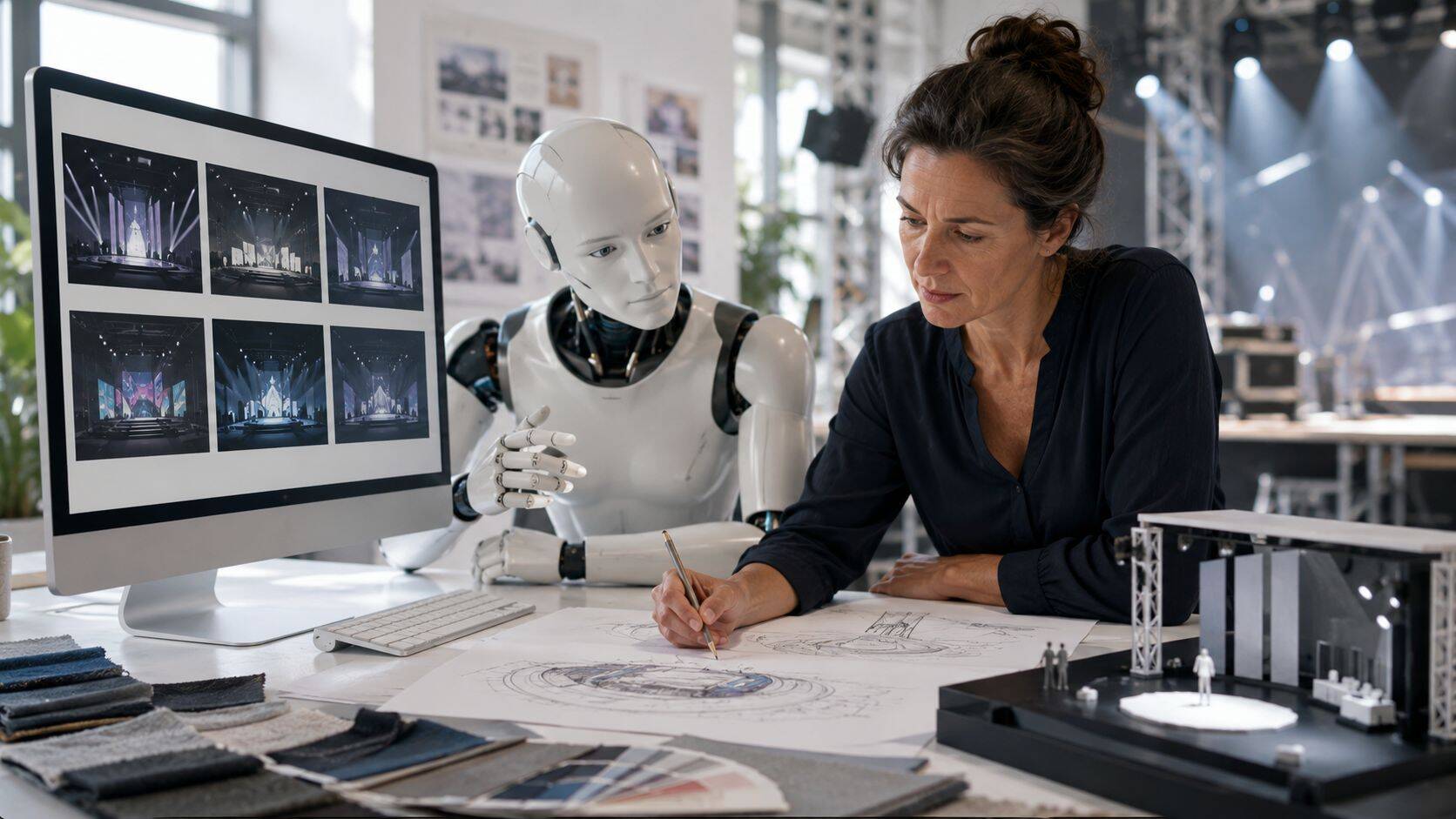
© demaerre – iStock by Gettyimages
It used to be a 100 percent creative process. Today, it goes like this: “I’ll just throw this into AI.” And boom: ten event ideas, five themes, three story arcs, a sustainability message, and a reasonably emotional closing. All in less than a minute. It used to take a team several days of workshops to get there. They’d fill countless flip charts, go through three boxes of cookies, play a round of foosball, say “purpose” five times, and work “disruptive” into the conversation at least once. Only to end up deciding: “We need to think bigger.”
Now the machine does the initial thinking. It’s useful. Very useful, in fact. AI is the new sparring partner: available anytime, always motivated, never offended, no lunch break, and always ready to produce “an innovative concept for a sustainable corporate event with a wow factor” at the drop of a hat. Unfortunately, the result often sounds exactly like that: an innovative concept for a sustainable corporate event with a wow factor. In other words, like everything and nothing.
Because this is where the catch lies: AI doesn’t automatically make things creative. First and foremost, it makes things fast. It organizes, formulates, combines, and tends to deliver what seems likely based on existing patterns. That can be extremely helpful. But it’s not the same as an original idea that had to work its way through resistance, experience, and a few bad ideas before it took shape.
Anyone who outsources too much of their thinking also risks challenging their own ideas less and less. That matters in an industry built on visions, atmosphere, storytelling, and real experiences. A strong event concept doesn’t come from neatly stacking words like immersive, sustainable, emotional, community-based, and AI-generated on top of one another. Even if that would make for a finished bowl of pitch soup.
The problem isn’t AI. It’s the person who clicks “Accept” with relief as soon as the first usable suggestion appears. Because it sounds polished. Because it looks professional. And because at first, no one in the meeting notices that the concept is about as unique as a welcome coffee with oat milk and psyllium cookies. You could also say that AI is democratizing mediocrity. Suddenly, anyone can make anything sound very polished, very quickly.
So the key question isn’t: “What can AI develop for us?” It’s: “What can we do with it so that it doesn’t sound like everything else?” AI can make the opening move. We still have to work out what makes it different. Because in the end, the event industry’s winner won’t be the concept that was written fastest. It will be the one that genuinely moves people, surprises them, or, at best, nudges them a little out of their routine. Otherwise, before long, everyone will be sitting in perfectly planned, maximally efficient, sustainably staged experiential environments with personalized content hubs, quietly wondering:
That’s how concepts emerge that get everything right and still fail to make an impact. They have target audiences, touchpoints, storytelling, purpose, QR codes, and hashtags. It’s all there. Except, unfortunately, for a soul. An algorithm can’t recognize goosebumps in the room. It doesn’t know when a moment shifts, when a production works, or when an audience mentally checks out. It can sketch out a story arc and identify patterns based on existing experience. But it can’t feel them.
AI can certainly be helpful. It can organize thoughts, develop variations, reveal blind spots, and take away some of the initial fear of the blank concept document. It just shouldn’t become the place where thinking stops.
© satis&fy
© memo-media Verlags-GmbH
© demaerre – iStock by Gettyimages
Those who build events mostly from prompts end up with concepts that sound polished but don’t make anyone in the room’s pulse quicken.
Why does this feel as though someone has prompted it exactly this way before...?
Everyone gets a little more creative.
Unfortunately, in the same direction.
AI provides ideas and variations. A distinctive event concept emerges when people make choices, ask questions, and build on what they have.
Is AI Making the Event Industry Complacent?
It used to be a 100 percent creative process. Today, it goes like this: “I’ll just throw this into AI.” And boom: ten event ideas, five themes, three story arcs, a sustainability message, and a reasonably emotional closing. All in less than a minute. It used to take a team several days of workshops to get there. They’d fill countless flip charts, go through three boxes of cookies, play a round of foosball, say “purpose” five times, and work “disruptive” into the conversation at least once. Only to end up deciding: “We need to think bigger.”
Now the machine does the initial thinking. It’s useful. Very useful, in fact. AI is the new sparring partner: available anytime, always motivated, never offended, no lunch break, and always ready to produce “an innovative concept for a sustainable corporate event with a wow factor” at the drop of a hat. Unfortunately, the result often sounds exactly like that: an innovative concept for a sustainable corporate event with a wow factor. In other words, like everything and nothing.
Because this is where the catch lies: AI doesn’t automatically make things creative. First and foremost, it makes things fast. It organizes, formulates, combines, and tends to deliver what seems likely based on existing patterns. That can be extremely helpful. But it’s not the same as an original idea that had to work its way through resistance, experience, and a few bad ideas before it took shape.
Anyone who outsources too much of their thinking also risks challenging their own ideas less and less. That matters in an industry built on visions, atmosphere, storytelling, and real experiences. A strong event concept doesn’t come from neatly stacking words like immersive, sustainable, emotional, community-based, and AI-generated on top of one another. Even if that would make for a finished bowl of pitch soup.
The problem isn’t AI. It’s the person who clicks “Accept” with relief as soon as the first usable suggestion appears. Because it sounds polished. Because it looks professional. And because at first, no one in the meeting notices that the concept is about as unique as a welcome coffee with oat milk and psyllium cookies. You could also say that AI is democratizing mediocrity. Suddenly, anyone can make anything sound very polished, very quickly.
So the key question isn’t: “What can AI develop for us?” It’s: “What can we do with it so that it doesn’t sound like everything else?” AI can make the opening move. We still have to work out what makes it different. Because in the end, the event industry’s winner won’t be the concept that was written fastest. It will be the one that genuinely moves people, surprises them, or, at best, nudges them a little out of their routine. Otherwise, before long, everyone will be sitting in perfectly planned, maximally efficient, sustainably staged experiential environments with personalized content hubs, quietly wondering:
That’s how concepts emerge that get everything right and still fail to make an impact. They have target audiences, touchpoints, storytelling, purpose, QR codes, and hashtags. It’s all there. Except, unfortunately, for a soul. An algorithm can’t recognize goosebumps in the room. It doesn’t know when a moment shifts, when a production works, or when an audience mentally checks out. It can sketch out a story arc and identify patterns based on existing experience. But it can’t feel them.
AI can certainly be helpful. It can organize thoughts, develop variations, reveal blind spots, and take away some of the initial fear of the blank concept document. It just shouldn’t become the place where thinking stops.