© VOK DAMS / Oliver Wachenfeld

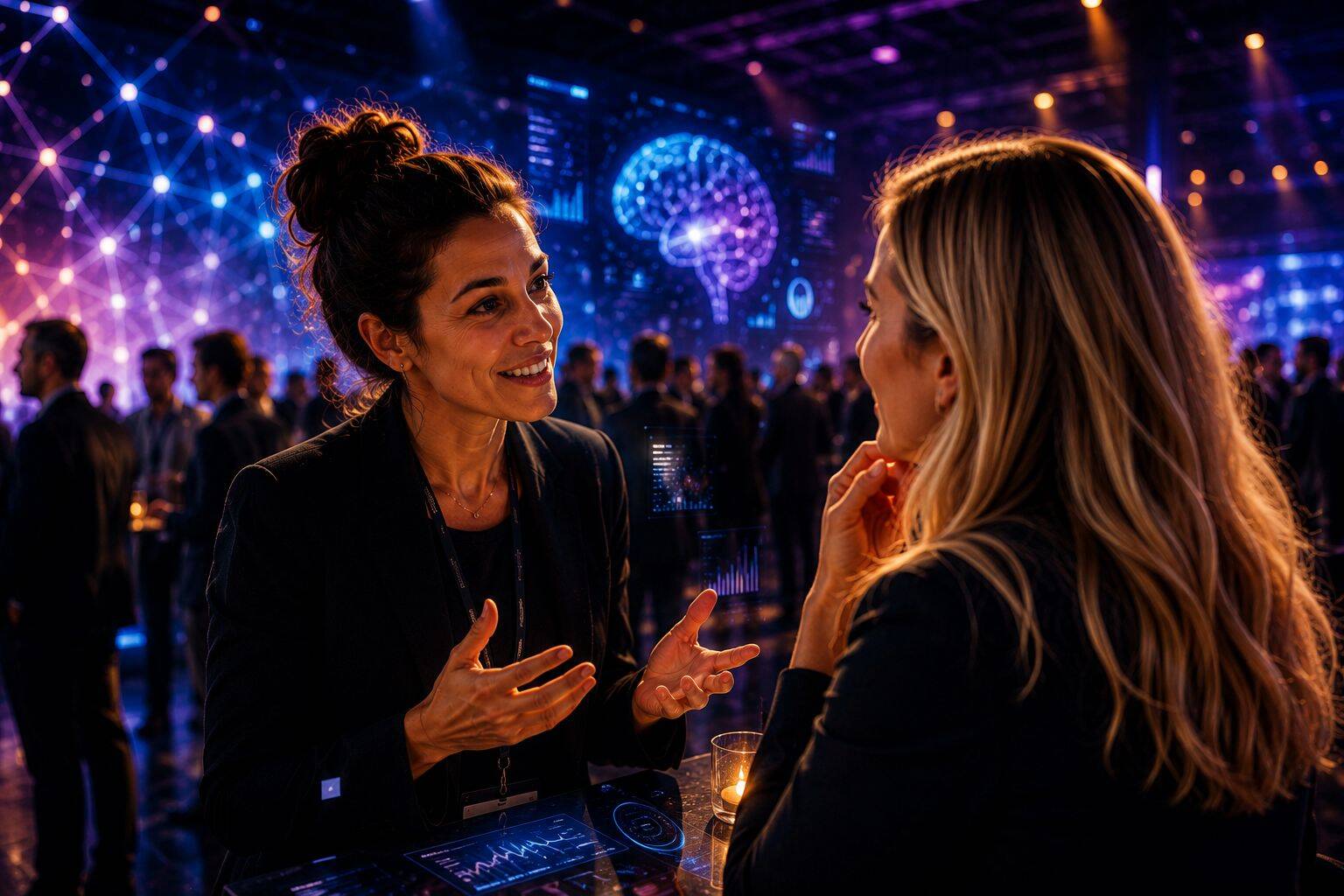
Bildnachweis: KI-generierte Illustration (2026)
At the Intersection of AI, Automation and Real Human Connection
About Colja Dams: Colja Dams is owner and Co-CEO of VOK DAMS worldwide, one of the world's leading agencies for events and live marketing. Founded in 1975, the company has received numerous international awards. In 2026, Dams himself ranked No. 1 in the international “Top 100 Event Agency Leaders” ranking. He is particularly passionate about advancing live communication: He focuses intensively on the potential of new technologies, drives innovation in live marketing, and continually seeks new ways to reach and inspire people, both live and virtually. www.vokdams.de
“AI will not determine which agency succeeds. What matters is who combines technology with judgment, creativity, and better ideas.”
With new event projects, you ask a very early question about the “Event Call to Action”: What should attendees think, feel, or do differently after an event? What concrete implications does this approach have for event design, and how does it change the role of format, stage, and staging?
Colja Dams: When we ask early in the planning process what attendees should think, feel, or do differently after the event, it changes the entire concept. For us, the Event Call to Action is therefore the strategic starting point: It defines the desired impact, and from there we derive the format, dramaturgy, and staging. To some extent, this turns traditional event logic on its head: not “What do we want to show on stage?” but “What should happen for the attendees, and what does it take to make that happen?” That might be a major production, but it could just as easily be a workshop, a Q&A session, or a format that seems much less spectacular at first glance. What matters is not the scale or the wow factor, but whether the format actually supports the desired change. In the end, what matters is not how spectacular an event was, but what is different afterward.
Using digital twins, VOK DAMS aims to simulate before an event how target audiences will respond to content, dramaturgy, and formats. You talk about the shift from post-data to pre-data and say, “We learn in advance what works.” How reliable are such forecasts already today, and how do you prevent data-driven recommendations from primarily reproducing familiar patterns of success and stifling creative moments of surprise?
Colja Dams: Our tests, validations, and specific projects to date show that these models already provide a very valuable basis for decision-making. Of course, AI is not a crystal ball that can predict the behavior of every single person with complete accuracy. But we can simulate very effectively how certain target audiences are likely to respond to content, messages, dramaturgy, or formats, where friction arises, and what creates impact. This allows us to create more targeted “made-for-me moments”: moments in which different attendees feel that this particular content, interaction, or format was made for them. And this is precisely where I see no contradiction with creativity. AI does not tell our creatives what they should come up with. Rather, it helps them test their ideas in advance and better assess whether they can achieve the desired impact. That can even lead to bolder events. If I have an unusual idea and get indications beforehand that my target audience understands it and that it will achieve the desired impact, I have a much stronger basis for actually being bold. Used correctly, AI should not make creativity smaller; it should give us the confidence to think bigger.
You emphasize the importance of “serendipity” — unplanned encounters that often create especially valuable moments for attendees. How can space be deliberately created for this when event planning is becoming increasingly precise through data and AI? Perhaps good events of the future will need to do both: deliberately plan for impact while preserving openness to the unexpected?
Colja Dams: Absolutely. Deliberately planning for impact does not mean controlling an event down to the last second. Quite the opposite: A good event must deliberately create breathing room. We talk a great deal about serendipity — those unplanned encounters and coincidences that sometimes become the most valuable moments for attendees. In practical terms, this starts with not overloading the program. If I schedule every minute and offer ten parallel sessions at the same time, there is hardly any room left to meet people, continue conversations, or discover something new. At the same time, it is not enough simply to put a one-hour networking break on the agenda and hope that serendipity will happen. Not everyone is a natural networker. That is why we need to consider how spaces, formats, and small prompts can support such encounters. Data and AI can help us better understand the structure behind this: Where does an event need orientation and guidance, and where can we deliberately leave room? That decision remains a conceptual task. Serendipity itself cannot be planned. But we can very deliberately create the conditions that make it more likely.
AI accelerates research, creation, project management, and personalization. If many agencies can access similarly powerful systems in the future, what will genuine differentiation come from? Which capabilities will become more valuable for agencies as a result, and which may become less important?
Colja Dams: AI is, first and foremost, a tool. And as with any tool, the result is determined not only by its capabilities, but by the person using it. If all agencies have access to similar models, the human factor therefore becomes all the more important. We are already seeing that AI-generated content can be interchangeable and generic. Differentiation then comes from judgment, experience, perspective, creativity, and the ability to ask the right questions. Of course, I can use AI extremely well as a sparring partner and arrive at ideas I might not have developed on my own. But someone has to provide the initial impulse. Someone has to recognize which idea is relevant. And in the end, someone has to take responsibility for whether the result is actually good.
At the same time, the skill profiles within agencies are shifting. Routine tasks and pure production will become less important. Skills at the intersections of strategy, creativity, data, and technology will become more valuable. For example, we will need more specialists who understand data, behavioral patterns, and simulations and can translate them into concrete recommendations for event design and experience. Close collaboration with client teams will also become more important, because expertise is needed where decisions are made.
Gleichzeitig verschieben sich die Kompetenzprofile in Agenturen. Routineaufgaben und reine Produktion werden an Bedeutung verlieren. Wertvoller werden Fähigkeiten an den Schnittstellen von Strategie, Kreation, Daten und Technologie. Wir werden beispielsweise mehr Spezialisten brauchen, die Daten, Verhaltensmuster und Simulationen verstehen und daraus konkrete Empfehlungen für Konzeption und Experience ableiten können. Auch die enge Zusammenarbeit mit Kundenteams wird wichtiger, weil Expertise dort gebraucht wird, wo Entscheidungen getroffen werden.
That is why I believe the decisive question will not be who has the best AI. It will be who can use the same technological possibilities to make better decisions, develop better ideas, and create better experiences.
Your agency operates internationally. Recently, you have particularly highlighted the speed at which events are planned and delivered in China. What can European companies actually learn from this “China Speed,” and where would it be a mistake simply to equate speed with progress?
Colja Dams: What we can take from China is the willingness to make decisions earlier and organize implementation more in parallel. In China, we sometimes see extremely short lead times of four to six weeks. That is impressive, but it is not automatically something we should simply copy. What matters are the principles behind it: fewer sequential processes, faster decisions, and the willingness to take responsibility earlier. European companies can learn exactly that without sacrificing quality, safety, or strategic rigor. Speed must never be confused with haste. Especially for events on the scale we work on, quality and safety are non-negotiable. The key question, therefore, is: How can we make decisions faster without making worse decisions?
This is exactly where new technologies can help us as well. If, for example, we can use digital twins to simulate concepts and decisions in advance with the relevant target audience, we reduce uncertainty and can gain clarity more quickly. For me, “China Speed” therefore does not mean doing everything faster. It means removing unnecessary waiting time from decisions and processes.
Looking ahead to 2030: If content can be generated largely automatically, digital communication can be scaled almost without limit, and AI takes over more and more processes, what will be the true luxury of live communication? And how will we know whether an event is genuinely future-ready?
Colja Dams: I would disagree with one point in the question: For me, live communication will not become a luxury. It remains something profoundly human. People have always felt the need to come together, exchange ideas, and experience things collectively. We all carry this campfire gene within us. AI, virtual worlds, and automated communication do not change that. What changes is the context. When content is available in practically unlimited quantities and digital communication becomes increasingly easy to scale, real-world interaction takes on even greater importance. Shared time, genuine attention, and the feeling of having experienced something together cannot simply be scaled or automated. That is why, for me, technology will not determine whether an event is future-ready in 2030. What matters is the Reason to Come: Is there a genuine reason why people should come together for it? And does it create real value for both sides? The company must achieve its goals through the event. At the same time, attendees must experience something that is relevant to them, moves them, gives them something to take away, and gives them a reason to come back. That is precisely where the future of live lies. The more digital and automated our communication becomes, the more valuable the moments become that we cannot digitize. Live is mission critical.
AI is changing how events are planned, managed, and evaluated. At the same time, in an increasingly digitized world, the desire for real human connection is growing. What does this mean for the future of live communication? boe international spoke with Colja Dams, Co-CEO of event and communications agency VOK DAMS, about AI, data-driven planning, and creative differentiation. And about what will make live events distinctive in the future.
The more digital our communication becomes, the more valuable real-world interaction seems to become. At the same time, you are observing a veritable “tsunami” of AI-generated content on social media. Will live communication become even more important in the future precisely because it offers something that is becoming increasingly scarce in the digital world: undivided attention and personal interaction?
Colja Dams: Absolutely. Live communication is the counterpoint to what we are currently experiencing in the digital space. And it is not something that will only gain importance in the future; it is already doing so today. The more communication becomes automated, personalized, and almost infinitely scalable, the more valuable the things become that cannot be scaled at will: genuine presence, personal interaction, focused attention, and moments experienced together. Or, put more pointedly: The more perfect the copy becomes, the more valuable the original becomes. This is also reflected in the numbers. EventTrack 2026, for example, shows that 57 percent of B2B and B2C attendees intend to attend more events. At the same time, brands continue to invest heavily in live experiences and are increasingly placing events at the center of their marketing activities. And that is exactly what we see in our day-to-day work as well. Companies are very deliberately looking for places and moments where people do not merely take in information, but build relationships, develop trust, and truly experience brands. Not as a nostalgic countertrend to digitization, but precisely because the rest of our world is becoming ever more digital.
“The more digital and automated communication becomes, the more valuable real human connection, shared attention, and experiences that cannot be scaled at will become.”
Bildnachweis: KI-generierte Illustration (2026)
At the Intersection of AI, Automation and Real Human Connection
© VOK DAMS / Oliver Wachenfeld

AI is changing how events are planned, managed, and evaluated. At the same time, in an increasingly digitized world, the desire for real human connection is growing. What does this mean for the future of live communication? boe international spoke with Colja Dams, Co-CEO of event and communications agency VOK DAMS, about AI, data-driven planning, and creative differentiation. And about what will make live events distinctive in the future.
The more digital our communication becomes, the more valuable real-world interaction seems to become. At the same time, you are observing a veritable “tsunami” of AI-generated content on social media. Will live communication become even more important in the future precisely because it offers something that is becoming increasingly scarce in the digital world: undivided attention and personal interaction?
Colja Dams: Absolutely. Live communication is the counterpoint to what we are currently experiencing in the digital space. And it is not something that will only gain importance in the future; it is already doing so today. The more communication becomes automated, personalized, and almost infinitely scalable, the more valuable the things become that cannot be scaled at will: genuine presence, personal interaction, focused attention, and moments experienced together. Or, put more pointedly: The more perfect the copy becomes, the more valuable the original becomes. This is also reflected in the numbers. EventTrack 2026, for example, shows that 57 percent of B2B and B2C attendees intend to attend more events. At the same time, brands continue to invest heavily in live experiences and are increasingly placing events at the center of their marketing activities. And that is exactly what we see in our day-to-day work as well. Companies are very deliberately looking for places and moments where people do not merely take in information, but build relationships, develop trust, and truly experience brands. Not as a nostalgic countertrend to digitization, but precisely because the rest of our world is becoming ever more digital.
With new event projects, you ask a very early question about the “Event Call to Action”: What should attendees think, feel, or do differently after an event? What concrete implications does this approach have for event design, and how does it change the role of format, stage, and staging?
Colja Dams: When we ask early in the planning process what attendees should think, feel, or do differently after the event, it changes the entire concept. For us, the Event Call to Action is therefore the strategic starting point: It defines the desired impact, and from there we derive the format, dramaturgy, and staging. To some extent, this turns traditional event logic on its head: not “What do we want to show on stage?” but “What should happen for the attendees, and what does it take to make that happen?” That might be a major production, but it could just as easily be a workshop, a Q&A session, or a format that seems much less spectacular at first glance. What matters is not the scale or the wow factor, but whether the format actually supports the desired change. In the end, what matters is not how spectacular an event was, but what is different afterward.
Using digital twins, VOK DAMS aims to simulate before an event how target audiences will respond to content, dramaturgy, and formats. You talk about the shift from post-data to pre-data and say, “We learn in advance what works.” How reliable are such forecasts already today, and how do you prevent data-driven recommendations from primarily reproducing familiar patterns of success and stifling creative moments of surprise?
Colja Dams: Our tests, validations, and specific projects to date show that these models already provide a very valuable basis for decision-making. Of course, AI is not a crystal ball that can predict the behavior of every single person with complete accuracy. But we can simulate very effectively how certain target audiences are likely to respond to content, messages, dramaturgy, or formats, where friction arises, and what creates impact. This allows us to create more targeted “made-for-me moments”: moments in which different attendees feel that this particular content, interaction, or format was made for them. And this is precisely where I see no contradiction with creativity. AI does not tell our creatives what they should come up with. Rather, it helps them test their ideas in advance and better assess whether they can achieve the desired impact. That can even lead to bolder events. If I have an unusual idea and get indications beforehand that my target audience understands it and that it will achieve the desired impact, I have a much stronger basis for actually being bold. Used correctly, AI should not make creativity smaller; it should give us the confidence to think bigger.
You emphasize the importance of “serendipity” — unplanned encounters that often create especially valuable moments for attendees. How can space be deliberately created for this when event planning is becoming increasingly precise through data and AI? Perhaps good events of the future will need to do both: deliberately plan for impact while preserving openness to the unexpected?
Colja Dams: Absolutely. Deliberately planning for impact does not mean controlling an event down to the last second. Quite the opposite: A good event must deliberately create breathing room. We talk a great deal about serendipity — those unplanned encounters and coincidences that sometimes become the most valuable moments for attendees. In practical terms, this starts with not overloading the program. If I schedule every minute and offer ten parallel sessions at the same time, there is hardly any room left to meet people, continue conversations, or discover something new. At the same time, it is not enough simply to put a one-hour networking break on the agenda and hope that serendipity will happen. Not everyone is a natural networker. That is why we need to consider how spaces, formats, and small prompts can support such encounters. Data and AI can help us better understand the structure behind this: Where does an event need orientation and guidance, and where can we deliberately leave room? That decision remains a conceptual task. Serendipity itself cannot be planned. But we can very deliberately create the conditions that make it more likely.
AI accelerates research, creation, project management, and personalization. If many agencies can access similarly powerful systems in the future, what will genuine differentiation come from? Which capabilities will become more valuable for agencies as a result, and which may become less important?
Colja Dams: AI is, first and foremost, a tool. And as with any tool, the result is determined not only by its capabilities, but by the person using it. If all agencies have access to similar models, the human factor therefore becomes all the more important. We are already seeing that AI-generated content can be interchangeable and generic. Differentiation then comes from judgment, experience, perspective, creativity, and the ability to ask the right questions. Of course, I can use AI extremely well as a sparring partner and arrive at ideas I might not have developed on my own. But someone has to provide the initial impulse. Someone has to recognize which idea is relevant. And in the end, someone has to take responsibility for whether the result is actually good.
At the same time, the skill profiles within agencies are shifting. Routine tasks and pure production will become less important. Skills at the intersections of strategy, creativity, data, and technology will become more valuable. For example, we will need more specialists who understand data, behavioral patterns, and simulations and can translate them into concrete recommendations for event design and experience. Close collaboration with client teams will also become more important, because expertise is needed where decisions are made.
Gleichzeitig verschieben sich die Kompetenzprofile in Agenturen. Routineaufgaben und reine Produktion werden an Bedeutung verlieren. Wertvoller werden Fähigkeiten an den Schnittstellen von Strategie, Kreation, Daten und Technologie. Wir werden beispielsweise mehr Spezialisten brauchen, die Daten, Verhaltensmuster und Simulationen verstehen und daraus konkrete Empfehlungen für Konzeption und Experience ableiten können. Auch die enge Zusammenarbeit mit Kundenteams wird wichtiger, weil Expertise dort gebraucht wird, wo Entscheidungen getroffen werden.
That is why I believe the decisive question will not be who has the best AI. It will be who can use the same technological possibilities to make better decisions, develop better ideas, and create better experiences.
“The more digital and automated communication becomes, the more valuable real human connection, shared attention, and experiences that cannot be scaled at will become.”
Your agency operates internationally. Recently, you have particularly highlighted the speed at which events are planned and delivered in China. What can European companies actually learn from this “China Speed,” and where would it be a mistake simply to equate speed with progress?
Colja Dams: What we can take from China is the willingness to make decisions earlier and organize implementation more in parallel. In China, we sometimes see extremely short lead times of four to six weeks. That is impressive, but it is not automatically something we should simply copy. What matters are the principles behind it: fewer sequential processes, faster decisions, and the willingness to take responsibility earlier. European companies can learn exactly that without sacrificing quality, safety, or strategic rigor. Speed must never be confused with haste. Especially for events on the scale we work on, quality and safety are non-negotiable. The key question, therefore, is: How can we make decisions faster without making worse decisions?
This is exactly where new technologies can help us as well. If, for example, we can use digital twins to simulate concepts and decisions in advance with the relevant target audience, we reduce uncertainty and can gain clarity more quickly. For me, “China Speed” therefore does not mean doing everything faster. It means removing unnecessary waiting time from decisions and processes.
Looking ahead to 2030: If content can be generated largely automatically, digital communication can be scaled almost without limit, and AI takes over more and more processes, what will be the true luxury of live communication? And how will we know whether an event is genuinely future-ready?
Colja Dams: I would disagree with one point in the question: For me, live communication will not become a luxury. It remains something profoundly human. People have always felt the need to come together, exchange ideas, and experience things collectively. We all carry this campfire gene within us. AI, virtual worlds, and automated communication do not change that. What changes is the context. When content is available in practically unlimited quantities and digital communication becomes increasingly easy to scale, real-world interaction takes on even greater importance. Shared time, genuine attention, and the feeling of having experienced something together cannot simply be scaled or automated. That is why, for me, technology will not determine whether an event is future-ready in 2030. What matters is the Reason to Come: Is there a genuine reason why people should come together for it? And does it create real value for both sides? The company must achieve its goals through the event. At the same time, attendees must experience something that is relevant to them, moves them, gives them something to take away, and gives them a reason to come back. That is precisely where the future of live lies. The more digital and automated our communication becomes, the more valuable the moments become that we cannot digitize. Live is mission critical.
“AI will not determine which agency succeeds. What matters is who combines technology with judgment, creativity, and better ideas.”
About Colja Dams: Colja Dams is owner and Co-CEO of VOK DAMS worldwide, one of the world's leading agencies for events and live marketing. Founded in 1975, the company has received numerous international awards. In 2026, Dams himself ranked No. 1 in the international “Top 100 Event Agency Leaders” ranking. He is particularly passionate about advancing live communication: He focuses intensively on the potential of new technologies, drives innovation in live marketing, and continually seeks new ways to reach and inspire people, both live and virtually. www.vokdams.de